

Malas & Japa Beads
A mala is in your hand every day, so it should feel right: a knot between every bead, and a sumeru that tells your fingers when the round is done. Tulsi from Vrindavan, sandalwood from Mysore, sphatik cut in Jaipur, with the material named honestly on every one.
Sourcing model BCurated from a named artisan or workshop. The maker ships; Shiwalay adds the box, the card and the story.
Before you choose
How to buy malas
A japa mala is a tool, and the practice decides which one. Tulsi for Vishnu and Krishna, rudraksha for Shiva, sphatik for Lakshmi and Saraswati, rakta chandan for Devi. In the hand, two things matter: a knot between every bead, and a sumeru bead that sits right, so your fingers know when a round is done.
01
Match the bead to the mantra
Tradition pairs beads with deities. If you are not sure, tulsi and sphatik are welcome in any practice.
02
Always knotted
A knot between beads stops them grinding, keeps the count even under your fingers, and means a broken thread loses you one bead, not the whole mala.
03
One to count, one to wear
A counting mala lives in its pouch between sessions. A mala you wear takes sweat and sun. Buy two rather than wear out one.
6 products




Rakta Chandan Mala
Red sandalwood, 108+1 beads, 8 mm, hand-turned
₹1,649
Tirupati region, Andhra Pradesh

Kasauti Mala
Black touchstone japa mala, 108+1 beads, 8 mm
₹1,499
Beads cut in Jaipur, strung in Vrindavan

Vaijanti Mala
Vaijanti seed mala from Vrindavan, 108+1 seeds
₹699
Gathered and strung in Vrindavan, Braj
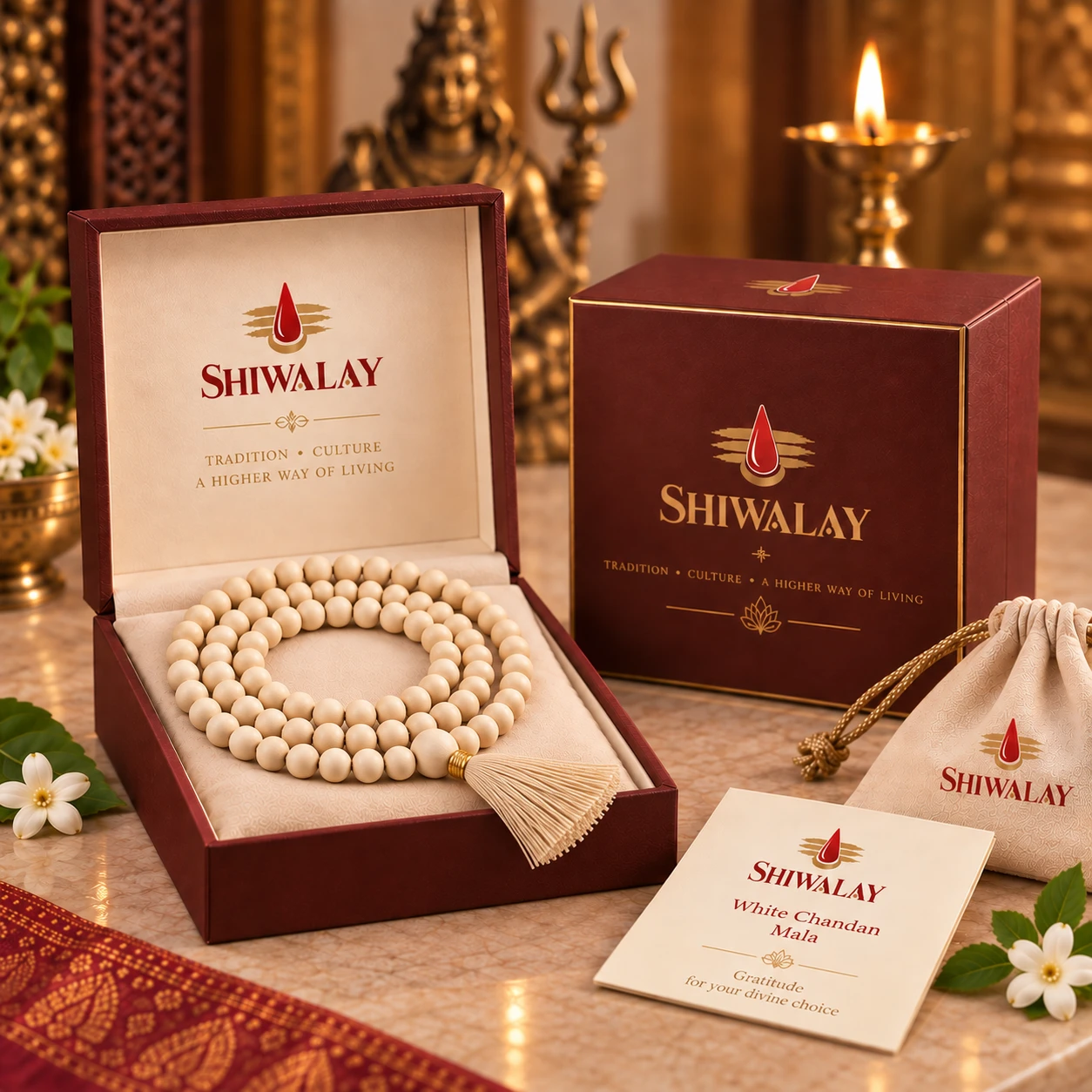
White Chandan Mala
White sandalwood japa mala from Mysuru, 108+1 beads, 8 mm
₹1,899
Turned in Mysuru, Karnataka
Questions people ask about malas
- How do I use a japa mala?
- Hold it in your right hand over the middle finger and move each bead toward you with your thumb, starting next to the sumeru. When you reach the sumeru, turn the mala and go back. Do not cross it.
- Can a mala be washed?
- Do not soak wood or seed malas. Wipe them with a dry cloth, and oil tulsi and rudraksha lightly once a month. Sphatik can be rinsed and dried.
- Which mala is best for which purpose?
- By deity: rudraksha for Shiva; tulsi, vaijanti and white chandan for Vishnu and Krishna; sphatik and pearl for Lakshmi and the Moon; rakta chandan for Devi. By planet in jyotish: pearl or moonstone for the Moon, green aventurine or jade for Mercury, citrine for Jupiter, rose quartz for Venus, amethyst or lapis for Saturn, and a navgraha mala for all nine. If you follow no single deity, a 7 chakra or sphatik mala suits any mantra.
- How do I know a gemstone mala is genuine?
- Ask for a gem lab card that names the stone and any treatment. The common swaps are opalite glass sold as moonstone, aventurine as jade, dyed quartz as amethyst or lapis, and copal or plastic as amber. Natural stones vary a little from bead to bead. Perfectly identical beads are usually glass.
- Why 108?
- It is the traditional Vedic count, often explained as the 27 nakshatras times their four padas. The sumeru bead marks the start and is never counted.